
Tabit POS Sales Playbook
Tabit is a strong fit for hospitality-driven merchants that need more than a basic counter POS: full-service restaurants, bars, resorts, hotels, private clubs, multi-venue properties, and operators with complex menus or table-service workflows.
The core positioning is mobile-first service, payment control, guest engagement, and hospitality integration. Tabit is best sold as a hospitality operating platform—not as a basic POS replacement—because it can support table service, bar tabs, kitchen operations, loyalty, reservations, online ordering, room charges, house accounts, complex menu workflows, and multi-outlet hospitality operations.
The best Tabit conversation is about how the business serves guests, manages payments, handles exceptions, connects systems, and retains customers—not simply about software price or hardware count.
Don't forget - unlike Toast or Spot-On that are payment processors disguised as POS, Tabit is the real deal and leaves payment processing and locked rates in the Agent's hands without pressure from WAll Street.
Overview
Tabit is a cloud-based, mobile-first hospitality platform designed for restaurants and hospitality properties where service happens beyond a fixed counter. Staff can take orders, manage checks, apply modifiers, access menu intelligence, process payments, manage guest information, and handle service workflows from mobile devices.
Tabit is especially well suited for operations focused on growth and revenues in excess of 1.5 million:
The platform can support:
- Tableside and mobile ordering
- Bar tabs and table-service payment workflows
- Incremental authorizations for growing checks
- Kitchen display systems and kitchen printing
- Online ordering, self-order, mobile ordering, and QR ordering
- Reservations, waitlist, guest management, promotions, loyalty, and gift cards
- House accounts and member-account charging
- Staff roles, permissions, and role-based tablet interfaces
- Hotel PMS integration and room-charge posting
- Centralized menu, pricing, modifier, and reporting controls
- Multi-location and multi-venue operations
- Surcharging and cash-discounting configurations
- Guest recovery through loyalty credits
Pricing structure
Tabit is generally sold as a solution-based hospitality platform rather than a fixed, self-service pricing tier. Pricing should be scoped based on the merchant’s operational requirements, number of locations, hardware devices, integrations, service model, payment volume, and implementation needs.
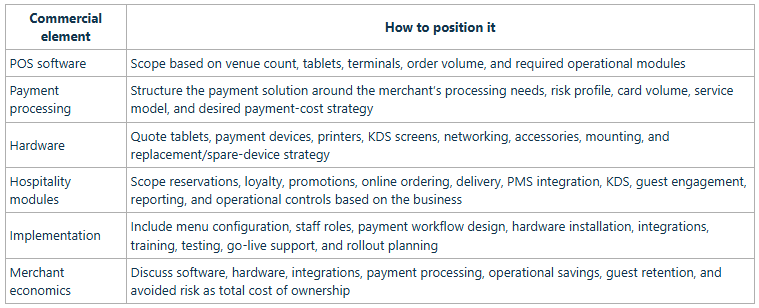
Do not position Tabit as a commodity POS quote. Position it around the operational and guest-experience value it creates:
“What does the operation need to serve guests faster, manage complex service, reduce payment risk, consolidate technology, recover dissatisfied guests, and support every revenue center on the property?”
What Tabit is designed to do
Mobile-first restaurant and bar service
Tabit is designed for staff to bring the POS workflow to the guest, rather than forcing every order, payment, or modification back to a fixed terminal.
Servers, bartenders, hosts, cashiers, managers, and hospitality staff can be configured with workflows appropriate to their job. Depending on the setup, employees can take orders, apply modifiers, manage tables, split checks, apply promotions, look up loyalty accounts, take payments, add tips, transfer checks, and close transactions from the floor.
This is valuable for:
- Tableside restaurant service, Busy bars and lounges
- Patio, rooftop, and outdoor dining, Poolside and beach service
- Hotel room service, Casino and resort dining, Event and banquet service, Private-club dining and member service
The message is:
“The POS goes where the guest is. Staff can serve, modify, pay, and recover the guest experience without returning to a fixed terminal for every step.”
Bar tabs and table-service payment control
One of Tabit’s strongest differentiators for bars, restaurants, clubs, and hospitality venues is support for true incremental authorizations.
A basic preauthorization can become a problem when a guest’s final spend materially exceeds the original authorization amount. This often occurs with bar tabs, open checks, bottle service, high-ticket dining, poolside service, resort transactions, and long-duration hospitality stays.
Card-brand authorization rules commonly create risk when the final transaction exceeds the original authorization by more than the permitted tolerance amount—often discussed operationally as the 120% preauthorization-overage threshold.
Tabit can support incremental authorization workflows that allow the authorized amount to increase as the guest’s tab grows.
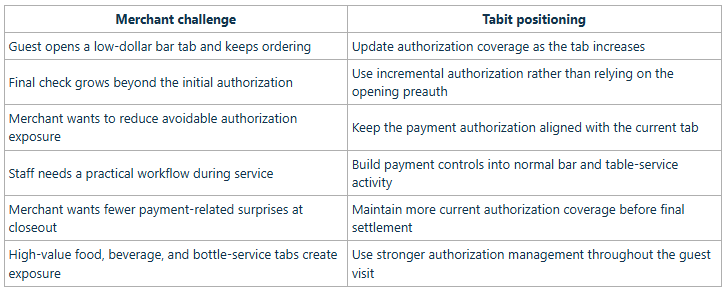
Positioning guardrail: Do not promise that incremental authorizations eliminate every decline, dispute, or chargeback. Position them as an important payment-risk control that helps reduce the risk created when a final transaction significantly exceeds the original authorization and potentially triggering automatic chargebacks.
Surcharging and cash discounting
Tabit supports compliant surcharging and true cash-discounting programs without using a dual-pricing model.
This creates an important payment-cost conversation for merchants that want to offset processing expense while maintaining a clear, consistent, and guest-friendly payment experience.
The right sales conversation is not simply “add a fee.” It is about implementing a properly configured payment program that considers:
- Card-brand rules
- State and local requirements
- Receipt presentation
- Staff communication
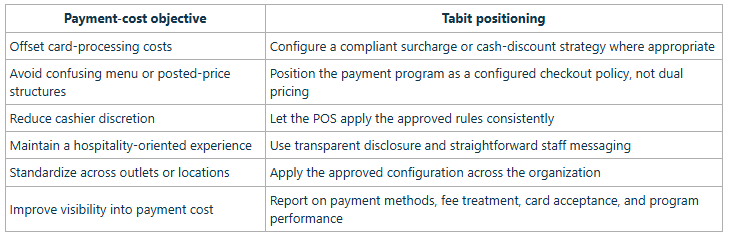
Positioning guardrail: Do not promise exact merchant savings, universal legality, or suitability without reviewing the merchant’s location, card acceptance mix, processing program, and compliance requirements. Avoid calling any configuration “no-cost processing.”
Private clubs and house accounts
Tabit supports house accounts, making it well suited for private clubs, country clubs, yacht clubs, social clubs, athletic clubs, golf clubs, member organizations, employee dining programs, corporate dining programs, and hospitality properties with internal billing requirements.
House accounts can support workflows such as:
- Corporate or Member charging, Deferred settlement
- Event-host or Sponsor accounts
- Internal-property accounts or Hotel-related posting accounts
- Club, Family, or household member accounts
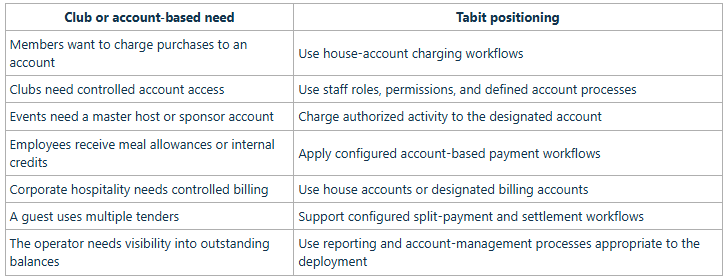
The positioning is:
“Tabit supports hospitality businesses where the guest or member does not always settle immediately by card. House accounts give clubs, hotels, and managed hospitality environments a structured way to manage account-based charging.”
Hotel, resort, and PMS integration
Tabit is especially well positioned for hotels, resorts, casinos, and multi-outlet hospitality properties because it can integrate restaurant and food-and-beverage activity with property-management systems.
This supports a connected guest experience across:
Hotel-related workflows can include:
- Room-charge posting
- Guest and room lookup
- Guest folio integration
- Property-account posting
- Multiple outlet support
- Guest check detail visibility
- Mixed payment methods
- QR-based room-service ordering
- Mobile ordering from guest locations
- Direct kitchen routing
- Property-wide reporting and revenue visibility
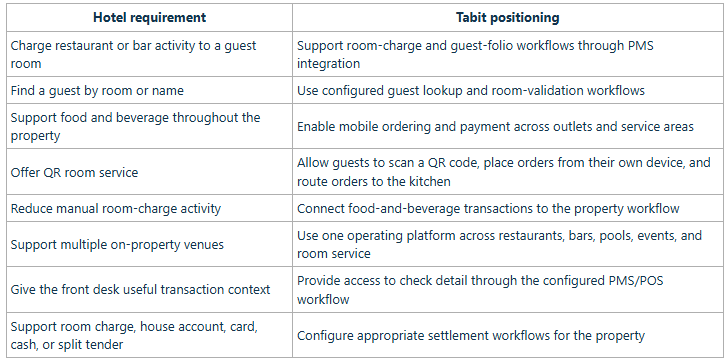
The message is:
“Tabit turns food and beverage into part of the hotel guest journey. A guest can order in a restaurant, poolside, at the bar, from a QR code in the room, or at another property venue—while the operation maintains connected ordering, kitchen, payment, and room-charge workflows.”
Complex menus and ordering
Tabit supports menu structures that often create training, order-accuracy, and upsell problems in lighter POS systems.
Tabit can support:
- Items that show included ingredients
- Standard modifiers, Nested modifiers, Required choices, Optional upgrades, Paid add-ons
- Categories and subcategories
- Preparation instructions, Item-level descriptions and allergy identification
- Complex recipe or ingredient workflows
- Complex prep ticket routing that varies by area
- Upsell prompts and configurable options
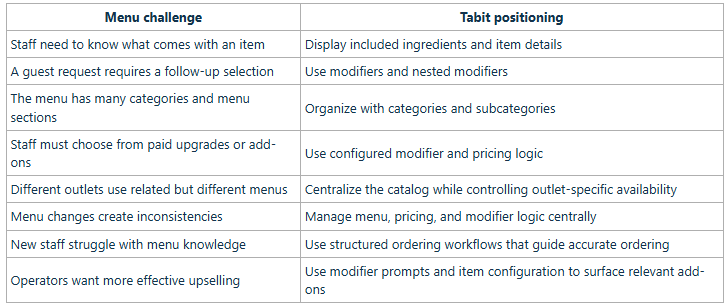
The message is:
“The merchant should not have to simplify its menu to fit the POS. Tabit can guide staff through detailed menu decisions so orders are accurate, faster to enter, and easier to upsell.”
Role-based staff experience
Tabit supports staff roles and permissions that can dynamically change the tablet user interface. Instead of giving every employee the same crowded set of features, Tabit can present each role with the tools relevant to that job.
This improves speed, reduces training burden, and supports stronger operational controls.
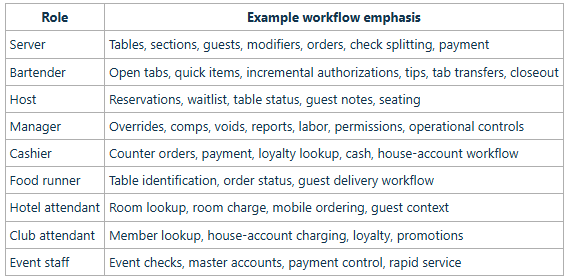
The message is:
“Tabit gives the right person the right screen for the job. Servers should see service tools, bartenders should see tab tools, hosts should see seating tools, and managers should see controls—not one universal screen for everyone.”
Reservations, promotions, loyalty, and guest retention
Tabit can bring reservations, guest information, loyalty, promotions, gift cards, online ordering, and operational service workflows into one hospitality technology strategy.
This helps operators avoid treating each customer interaction as an isolated transaction.
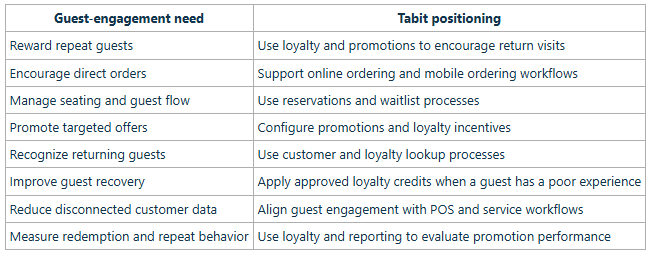
A particularly valuable service-recovery workflow is loyalty crediting.
Guest has a poor experience → Staff or manager acknowledges the issue → Authorized employee adds a loyalty credit → Guest has a tangible reason to return → Operator can track redemption and recovery performanceThis is better than relying only on a verbal apology or an untracked future promise. It gives the team a controlled, measurable way to encourage a second visit.
The message is:
“Loyalty is not only for points. It can be a service-recovery tool. When a guest leaves dissatisfied, an authorized employee can add a credit to that guest’s loyalty account and create a real reason for them to come back.”
Included value that often costs extra elsewhere
A strong Tabit sales conversation should focus on hospitality-stack consolidation.
Many merchants use separate products for:
- POS, Payment processing, Kitchen display systems
- Online ordering, QR ordering, Reservations, Waitlist management
- Loyalty, Gift cards, Promotions, Guest management
- Hotel PMS integration, Room-charge workflows, House accounts
- Labor and staffing tools, Multi-location controls, Delivery and aggregator integrations
Tabit can be positioned as a connected hospitality platform that reduces the need for disconnected systems, duplicate data entry, manual workarounds, and separate staff workflows.
The message is:
“The value is not just replacing the POS. The value is reducing the number of disconnected systems staff have to use to serve guests, manage payments, run the kitchen, recognize customers, and operate the property.”
Sales talk tracks
1. Start with service style, not product features
Do not begin with a generic POS feature checklist. Begin by understanding where and how guests are served.
Ask:
“Where does service happen today—at a counter, at tables, at the bar, poolside, in a guest room, at an event, or across multiple venues?”
Tabit is most compelling when the merchant has mobile service requirements, complex hospitality workflows, or multiple outlets.
2. Sell mobile hospitality, not merely tablet ordering
The Tabit story is not simply that staff can carry a tablet.
The stronger message is:
“Your staff can bring the complete service workflow to the guest: orders, modifiers, payment, table status, room charge, house accounts, loyalty, promotions, and service recovery—without repeatedly returning to a fixed station.”
3. Sell payment control for bar tabs and table service
Introduce incremental authorizations early for merchants with open tabs, extended service periods, bottle service, high-ticket dining, club dining, resort activity, or long table stays.
“The original preauthorization is often not enough when a guest keeps ordering. Tabit supports incremental authorization workflows that help keep the authorization aligned with the growing tab, reducing exposure created when the final amount materially exceeds the opening authorization.”
4. Sell the hotel and PMS story
For hotels, resorts, casinos, and multi-outlet properties, position Tabit as a property-wide hospitality platform.
“Tabit connects restaurant, bar, pool, event, and room-service operations into the broader hotel guest experience. Guests can order from multiple places on the property, staff can access the relevant room or guest workflow, and the operation can support room-charge and kitchen-routing processes.”
5. Sell the private-club and house-account story
For clubs, member organizations, and account-based hospitality properties:
“Tabit supports member and house-account workflows, so guests do not have to settle every transaction immediately by card. Staff can support controlled member charging, event accounts, internal accounts, and other account-based hospitality models.”
6. Sell menu intelligence and order accuracy
For merchants with detailed menus, focus on accuracy, training, service speed, and upsell opportunity.
“Tabit can show included ingredients, guide staff through modifiers and nested decisions, and organize menus into categories and subcategories. That helps newer staff take accurate orders, reduces kitchen mistakes, and makes upselling easier.”
7. Sell guest recovery, not just loyalty
“When a guest has a poor experience, the team should have more than an apology. An authorized employee can add a loyalty credit to the guest account, creating a real reason to return and giving management a measurable recovery process.”
8. Sell consolidated operations
“Instead of separate systems for POS, payments, reservations, loyalty, online ordering, KDS, guest management, room charges, and reporting, Tabit can support a more connected hospitality operating model.”
Qualification framework
Use the following questions to determine whether Tabit is a strong fit:
- Is the business full service, fine dining, bar-centric, hotel-based, club-based, resort-based, or hospitality intensive?
- Does service occur at the table, bar, patio, pool, beach, guest room, casino, event space, or multiple on-property outlets?
- Do servers need to take orders, modify items, split checks, and take payments away from a fixed terminal?
- Does the business maintain open bar tabs or extended guest checks?
- Do guest checks frequently grow beyond the opening authorization amount?
- Does the merchant need stronger authorization control for bar tabs or long-duration table service?
- Is the merchant a hotel, resort, casino, club, or multi-outlet property?
- Does the merchant use a property-management system today?
- Does the merchant need room charging, guest lookup, folio posting, or property-account charging?
- Would QR room service, poolside ordering, or mobile guest ordering improve service?
- Does the operation use member accounts, house accounts, event accounts, corporate accounts, or employee accounts?
- Does the menu include detailed ingredients, complex modifier choices, required selections, paid upgrades, nested modifiers, or subcategories?
- Do different staff roles need different tablet interfaces and permissions?
- Does the merchant need integrated reservations, waitlist, loyalty, promotions, gift cards, and guest management?
- Does the business need a documented service-recovery process for dissatisfied guests?
- Is the merchant considering a surcharge or cash-discount program?
- Is the merchant currently paying for separate POS, payments, loyalty, reservation, online-ordering, KDS, PMS, and reporting tools?
- Does the business operate multiple locations, outlets, concepts, or revenue centers?
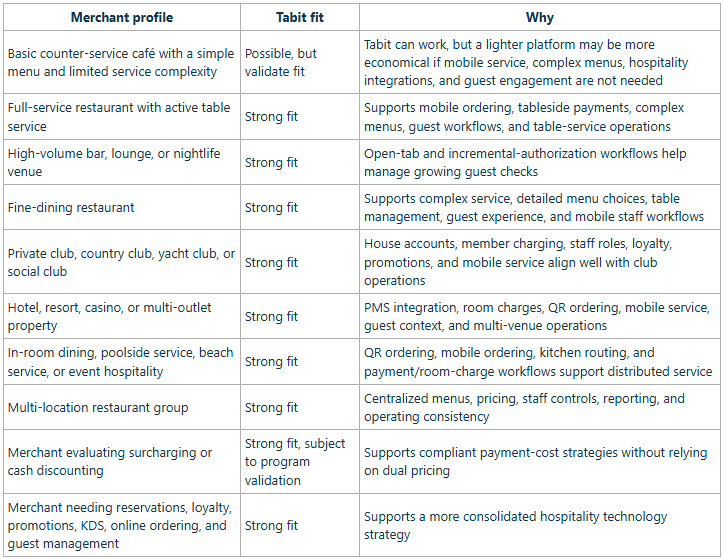
Simple recommendation guide
Example messaging reps can use
“Tabit is built for hospitality operations where service does not happen only at a fixed counter. It gives staff the ability to order, modify, pay, and manage the guest experience at the table, bar, pool, patio, event space, or guest room.”
“For bar tabs and extended table service, Tabit supports true incremental authorizations so the card authorization can keep pace with a growing tab rather than relying only on the opening preauthorization.”
“Tabit is more than restaurant POS. It can support mobile service, payments, kitchen operations, reservations, loyalty, promotions, house accounts, online ordering, hotel room-charge workflows, and guest engagement within the same hospitality strategy.”
“For hotels and resorts, guests can order by QR code in a room, at the pool, at the beach, or in another venue. Orders can route to the kitchen while the property maintains the appropriate room-charge and guest workflow.”
“Private clubs can use house accounts and member charging while still giving staff a modern, tablet-based service experience.”
“Your menu does not have to be flattened to fit the POS. Tabit can support included ingredients, nested modifiers, categories, subcategories, upgrades, and detailed ordering choices.”
“When a guest is dissatisfied, Tabit gives you a practical retention tool: an authorized employee can add a loyalty credit that gives the guest a reason to return.”
“Tabit can support compliant surcharge and cash-discount strategies without relying on dual pricing. The program is configured around the merchant’s payment workflow, disclosures, and compliance requirements.”
Positioning guardrails
Keep the following claims precise:
- Do not promise that Tabit supports every property-management system. Confirm the exact PMS, integration availability, version, modules, and implementation scope.
- Do not promise identical room-charge, guest lookup, folio posting, split settlement, void, tax, or posting-account behavior across every PMS integration.
- Do not promise that incremental authorizations eliminate all declines, chargebacks, disputes, or payment risk. Position them as a useful control for maintaining authorization coverage as tabs grow.
- Do not promise exact surcharge or cash-discount savings without reviewing the merchant’s payments profile and configured program.
- Do not call any program “no-cost processing.”
- Do not make blanket legal or compliance claims. Validate program design, disclosure, receipt treatment, state rules, card-brand rules, and payment method eligibility.
- Do not promise every module in every Tabit proposal. Scope reservations, loyalty, promotions, PMS, online ordering, KDS, guest management, analytics, and third-party integrations explicitly.
- Do not assume every house-account workflow is the same. Confirm account types, approval policies, member lookup methods, account limits, balance handling, and reporting needs.
- Do not assume that every loyalty implementation includes identical promotions, crediting permissions, reward rules, expiration policies, or customer-identification methods.
- Do not promise a native integration merely because a vendor appears in an integration category. Validate the exact connection, commercial arrangement, use case, and implementation effort.
- Do not lead with features that are not relevant to the merchant’s service style. Lead with the operational problem and demonstrate the relevant workflow.
Sales advantages
- Mobile-first hospitality workflow for tableside, bar-side, poolside, event, and in-room service.
- Strong positioning for full-service, upscale, and fine-dining restaurant operations.
- True incremental authorization capability for bar tabs and growing guest checks.
- Compliant surcharge and cash-discount support without dual pricing.
- House-account capability for private clubs, member organizations, employee programs, corporate accounts, event accounts, and hospitality properties.
- Hotel and resort positioning through PMS integration, room-charge workflows, QR ordering, and multi-outlet support.
- QR and mobile ordering for room service, poolside service, event spaces, and distributed hospitality operations.
- Menu sophistication: included ingredients, modifiers, nested modifiers, categories, subcategories, pricing rules, and centralized menu controls.
- Staff-role configurations that can dynamically change tablet UI and permissions.
- Reservations, waitlist, loyalty, promotions, gift cards, online ordering, kitchen operations, and guest engagement in one broader technology strategy.
- Loyalty-credit service recovery that gives dissatisfied guests a measurable reason to return.
- Multi-location and multi-outlet controls for menus, pricing, reporting, and operating standards.
- Better fit for hospitality businesses that have outgrown a counter-centric POS.
Deficiencies to expose in other providers
- Some POS systems are counter-centric and force servers to return to a fixed station for orders, changes, payments, or check splitting.
- Some restaurant systems rely only on basic preauthorization behavior and do not offer a practical incremental-authorization workflow for growing tabs.
- Some platforms require hotels to use separate systems for POS, PMS posting, room charges, in-room ordering, and mobile service.
- Some restaurant POS products are not designed for house accounts, member charging, event accounts, or private-club settlement workflows.
- Some lighter POS systems cannot cleanly support complex menus, included ingredients, nested modifiers, categories, and subcategories.
- Some providers require separate products for reservations, loyalty, promotions, KDS, online ordering, guest management, and reporting.
- Some systems show every employee the same interface, creating clutter, training burden, and weak role controls.
- Some loyalty programs only reward purchases and do not support a practical, controlled guest-recovery credit strategy.
- Some payment-cost programs rely on confusing price presentation or are not implemented with appropriate compliance review.
- Some multi-venue operators manage inconsistent menus, pricing, reporting, and guest data across disconnected systems.
- Some POS vendors are effective for basic transactions but do not scale well into complex hospitality operations.
Messaging angles
Hospitality angle: Tabit is mobile-first hospitality technology, not just a fixed-terminal POS.
Tableside angle: Staff can take orders, modify checks, split payments, add tips, and close transactions without interrupting service.
Bar-tab angle: Incremental authorizations help keep authorization coverage aligned with growing bar tabs and table-service checks.
Payment-cost angle: Support compliant surcharge or cash-discount programs without relying on dual pricing.
Hotel angle: Connect restaurant, bar, pool, event, and room-service operations to the broader hotel guest workflow.
QR room-service angle: Let guests scan, order from their own device, route the order directly to the kitchen, and use the appropriate configured payment or room-charge workflow.
Private-club angle: Use house accounts and member charging with modern mobile service.
Menu angle: Support included ingredients, modifiers, nested modifiers, categories, subcategories, upgrades, and detailed item configuration.
Guest-recovery angle: Turn a poor guest experience into a reason to return with an approved loyalty credit.
Consolidation angle: Bring POS, payments, kitchen operations, reservations, loyalty, online ordering, guest management, house accounts, hotel workflows, and reporting into a connected hospitality strategy.
Role-based angle: Give servers, bartenders, hosts, cashiers, managers, club attendants, and hotel staff the screens and permissions appropriate to their roles.
Discovery questions
- How much of your service happens away from a fixed counter—at tables, the bar, patio, pool, beach, casino, event space, or guest room?
- Are staff currently walking back to a terminal to enter orders, make changes, split checks, or take payment?
- Do you keep bar tabs open for extended periods?
- Do guest checks frequently exceed the original preauthorization amount?
- How do you handle authorization coverage today when a guest keeps ordering?
- Are you a hotel, resort, casino, private club, or multi-outlet hospitality property?
- Do you use a PMS today? Which system?
- Do you need room charges, guest lookup, folio posting, or property-account charging?
- Would QR room service, poolside ordering, mobile ordering, or guest self-ordering improve operations?
- Do you operate member accounts, house accounts, employee meal accounts, event accounts, corporate accounts, or sponsor accounts?
- Do you need one check split across room charge, house account, card, cash, or other tender types?
- How complex is your menu? Do you need included ingredients, forced choices, paid upgrades, nested modifiers, subcategories, or special preparation instructions?
- Do different roles need different tablet interfaces and permissions?
- Are reservations, waitlist, loyalty, promotions, gift cards, and guest management separate products today?
- What happens when a guest is dissatisfied? Do you have a controlled and measurable recovery process?
- Are you considering a surcharge or cash-discount program?
- Which technology subscriptions, manual workarounds, and integration fees are you trying to reduce?
- Do you operate multiple locations, outlets, brands, menus, or service models that need centralized control?
Proof points to validate in demo
- Show tablet-based server ordering and tableside payment workflow.
- Demonstrate how a bar tab is opened, reviewed, and incrementally authorized as guest spending grows.
- Show check splitting by seat, item, tender, or guest.
- Demonstrate multiple settlement methods where relevant, including card, cash, room charge, house account, and split-payment scenarios.
- Show staff roles and how the tablet UI changes for a server, bartender, host, manager, cashier, hotel attendant, or club attendant.
- Demonstrate an item with included ingredients, modifiers, nested modifiers, categories, and subcategories.
- Show complex order entry with upgrades, special instructions, modifier dependencies, and upsell opportunities.
- Demonstrate reservation, waitlist, guest lookup, promotion, loyalty, and customer-recognition workflows within the proposed scope.
- Show how an authorized employee applies a loyalty credit for service recovery.
- Demonstrate house-account lookup, charging rules, authorization controls, and reporting for private-club or member-account prospects.
- For hotel prospects, demonstrate the exact PMS workflow: guest lookup, room-charge posting, property-account use, check detail, void treatment, and applicable QR/mobile ordering flow.
- Show how QR/mobile orders route to the correct kitchen display or printer destination.
- Demonstrate surcharge or cash-discount configuration, disclosure presentation, receipt treatment, and reporting based on the merchant’s proposed program.
- Show multi-outlet or multi-location menu, pricing, reporting, role, and control capabilities where relevant.
Objection handling
“We just need something simple.”
That may be true if the operation is a basic counter-service environment. But if staff take orders at tables, manage open bar tabs, use complex modifiers, need reservations or loyalty, operate house accounts, or support hotel guests, a basic POS often creates manual workarounds and separate-system costs.
The right question is:
“Are you buying for the simplest transaction you have today, or for the service operation you need to run as the business grows?”
“Our current system already takes payments.”
Taking a payment is not the same as controlling a hospitality payment workflow.
The relevant question is whether the system can support:
- Growing bar tabs
- Incremental authorizations
- Tableside service
- Mobile payment
- House accounts
- Room charges
- Split settlements
- Complex guest checks
- Guest recovery
- Property-wide operations
“We already have a property-management system.”
That is exactly why the PMS conversation matters. Tabit is not positioned as a replacement for the PMS. It is designed to connect food-and-beverage service to the broader guest experience through configured room-charge, guest lookup, folio-posting, and mobile-ordering workflows.
Confirm the merchant’s exact PMS and integration scope before making a final commitment.
“We already have reservations and loyalty.”
The question is whether those tools are connected to service and payment activity.
If reservations, POS, loyalty, promotions, guest recovery, online ordering, KDS, and reporting are separate, staff lose context and managers lose visibility. Tabit can be positioned as a way to create a more connected guest journey rather than requiring the merchant to keep adding disconnected tools.
“Our menu is too complicated for a tablet POS.”
That is a qualification point in Tabit’s favor.
Demonstrate included ingredients, modifier logic, nested modifiers, categories, subcategories, upgrades, and role-appropriate ordering screens. The merchant should not need to simplify the menu just to make the technology work.
“We cannot afford payment problems on bar tabs.”
That is why incremental authorizations matter.
Tabit supports a workflow that helps the merchant keep payment authorization more closely aligned with the guest’s growing tab instead of relying solely on the opening preauthorization. Final configuration should reflect the merchant’s processing setup, service model, and payment policies.
“We do not want to upset guests with payment fees.”
The payment program should be designed around transparent disclosure, consistent system behavior, appropriate staff training, and the merchant’s market—not a surprise fee at checkout.
Position surcharge or cash-discount options as a properly configured payment strategy, subject to the merchant’s eligibility and compliance review.
“We do not want a large technology project.”
Scope the immediate business problem first, then create a growth roadmap.
For example:
Restaurant: Mobile POS + payments + menu configuration + KDS
Bar: Mobile POS + tabs + incremental authorizations + payments
Private club: Mobile POS + house accounts + member workflows + loyalty
Hotel: Mobile POS + PMS integration + room charges + QR room service + KDS
Multi-location group: POS + central menus + roles + reporting + guest engagement
The goal is not to sell every module on day one. The goal is to avoid choosing a limited system that forces the merchant into a replacement project once hospitality complexity grows.
Talk track
Tabit is a strong fit for hospitality operators that need their POS to do more than ring up a sale. It is built for restaurants, bars, hotels, resorts, private clubs, and multi-venue properties where staff serve guests at the table, at the bar, poolside, in an event space, or in-room—not only from behind a fixed counter.
The strongest Tabit conversation is about the guest journey and operational control. Staff can work from role-appropriate tablet interfaces; menus can handle included ingredients, nested modifiers, categories, and subcategories; reservations, promotions, loyalty, and service recovery can operate within the same technology strategy; and private clubs can manage member and house-account charging.
For bars and table-service venues, Tabit’s incremental-authorization capability is a meaningful payment-control differentiator. It helps the merchant keep card authorization coverage aligned with a growing tab rather than relying on an original preauthorization that may no longer cover the final check.
For hotels and resorts, Tabit can connect restaurant, pool, event, bar, and room-service experiences to broader guest and PMS workflows. Guests can order through a QR code in-room, at the pool, or elsewhere on the property; orders can route to the kitchen; and the configured payment or room-charge workflow can support a more seamless hospitality experience.
The best Tabit sale is not about finding the lowest monthly POS subscription. It is about delivering better hospitality, reducing disconnected systems, improving payment control, handling complex service, building guest loyalty, recovering dissatisfied guests, and giving the operator one platform that can support the full guest experience.