
POS ROUND-UP:
Clover, Square, OrderCounter, Union, Korona, & Tabit
Summary: POS Roundup compares our POS offerings to one another, suggests best fits by vertical and operational need, highlights unique features, and identifies merchant characteristics that help predict the best-fit POS outcome for each brand.

Key Takeaways
Verticals and merchant characteristics to help predict best-fit POS outcomes
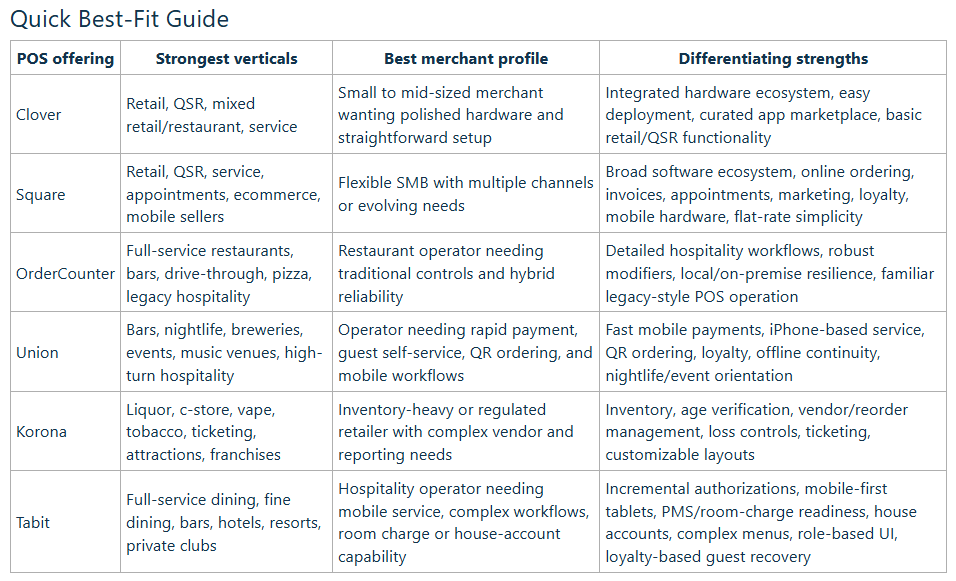
Clover POS stands out for small to mid-sized retailers, QSRs, and mixed retail/restaurant brands needing modern, easy-to-navigate hardware, basic inventory and reporting, basic gift card and loyalty features, and an all-in-one system that integrates with ecommerce, mobile ordering, and online ordering.
Square POS offers feature-rich plans that require relatively few extra apps. Square excels at serving multi-prong sellers that do not neatly fit one specific vertical. It is slightly more complex than Clover, but those settings accommodate greater customization of UI, online ordering, invoicing, scheduling, customer engagement, and channel management.
OrderCounter POS is well suited for full-service, table-service, counter-service, drive-through restaurants, and bars looking for workflow customizations, multi-location support, and hybrid cloud/on-premise reliability.
Union POS remains a top choice for busy bars, nightclubs, and event venues that require rapid guest-led ordering, strong mobile and tableside workflows, hospitality-focused loyalty, guest engagement, QR ordering, and reliable operation during busy periods.
Korona POS is ideal for inventory-intensive, compliance-driven retailers, liquor stores, vape shops, c-stores, and ticketing/event venues because of its robust inventory, vendor, age-verification, loss-prevention, and highly customizable screen-layout capabilities. Supports tobacco scan data programs.
Tabit POS is best for hospitality-intensive operations that need mobile-first service, advanced table and bar workflows, hotel or resort connectivity, private-club house accounts, complex menus, guest engagement, and stronger payment controls. Tabit is particularly well suited for full-service restaurants, upscale dining, high-volume bars, hotels, resorts, casinos, private clubs, and multi-outlet hospitality properties.
Characteristics that help predict best POS outcomes
Best-fit Characteristics for:
Clover POS
Retail or quick-service restaurant focus: Best for small to mid-sized retailers and QSRs that want reliable, purpose-built hardware and straightforward workflows.
Merchants valuing aesthetics and ease of setup: Modern matching hardware for teams that want fewer configuration choices; Clover emphasizes a controlled, streamlined merchant experience.
Merchants valuing an integrated, branded ecosystem: Strong where merchants want bundled Clover hardware, Clover-managed service plans, and a curated app marketplace.
Multi-channel with curated integrations: Supports in-person and online ordering with inventory syncing via first- and third-party apps, though many specialized features rely on Marketplace apps or integrations.
Support for fee-reduction plans: Supports both surcharge and cash-discounting strategies.
Best overall fit: Smaller retailers, QSRs, salons, service businesses, simple restaurants, and merchants wanting an attractive all-in-one countertop solution with low implementation complexity.
Square POS
SMBs that need modest customization: Ideal when merchants want branding and UI options—on-screen layouts, button sizing, detailed modifier behavior, and per-unit pricing—even if setup takes longer.
Flexible operations that can pivot to mobile-first: Excellent for pop-ups, multi-location shops, mobile sellers, and businesses that need portable hardware plus cloud-based device management.
Merchants who desire more online-store customization: Square Online provides multiple ordering templates and styles, online/onsite menu visibility, and flexible order flows without necessarily requiring third-party tools.
Inventory options and tax precision: Strong for sellers needing fixed, variable, and per-unit costs; added or inclusive taxes; variants; modifiers; and pre-selected modifier ingredients.
Superior loyalty and marketing: Paid plans include granular loyalty and customer segmentation based on purchase behavior, supporting targeted outreach and offers.
Transparent, flat-rate pricing preference: Attracts merchants that prefer clear pay-as-you-go processing, simple subscriptions, and built-in services such as online ordering, appointments, invoicing, customer tools, and banking-related services.
Best overall fit: Multi-prong SMBs, growing retailers, quick-service restaurants, service businesses, appointment-based businesses, pop-ups, ecommerce sellers, and merchants that value flexible channel options.
OrderCounter POS
Table-service, traditional restaurants, and light retail: OrderCounter is ideal for restaurants that prefer the reliability and capabilities of a traditional hospitality POS but want cloud-based flexibility for back-office operations. Basic retail can be accommodated, but item variants and ecommerce are not its strongest fit.
Merchants with complex or legacy workflow requirements: OrderCounter is well suited for businesses seeking detailed, highly customizable features for managing intricate restaurant or bar operations. Modifier groups can show which ingredients are included and allow operational actions such as removing an ingredient, selecting “No,” adding “2x,” or making substitutions.
Those seeking hybrid cloud/on-premise solutions: Merchants concerned about internet downtime or data loss may prefer OrderCounter’s blend of in-store server reliability and cloud functions, compared with more cloud-first alternatives.
Businesses prioritizing traditional POS familiarity: If staff is accustomed to legacy restaurant POS systems, OrderCounter can provide a comfortable transition with robust support for conventional ordering, kitchen, table-service, and bar workflows.
Support for dual-pricing and cash discounting: Appropriate for merchants seeking payment-cost programs where a dual-pricing or cash-discount approach is acceptable to the operation.
Best overall fit: Traditional restaurants, full-service restaurants, bars, pizza concepts, drive-through operations, operators with complex legacy workflows, and merchants who place a premium on local reliability and familiar hospitality controls.
Union POS
Bars, nightclubs, and event venues: Union POS is purpose-built for environments with high guest turnover, requiring rapid ordering and payment, guest-led features, QR-based ordering, and fast transaction handling.
Mobile, tableside, and contactless ordering: Union is especially strong where staff efficiency, mobile payments, iPhone-based handheld workflows, and customer self-service are central to the operation.
Seamless guest engagement and loyalty: Robust modules for tracked loyalty, digital ordering, post-event marketing, and guest engagement give Union a strong hospitality and nightlife edge.
Offline reliability: Union’s continuity features are valuable where network outages would disrupt peak bar, nightclub, festival, stadium, or event-venue operations.
Built for speed and fast-turn settings: Offers optimized payment flows and modular controls, including compliant surcharge and cash-discounting options, making it ideal for rapid cash-outs, high-volume beverage sales, and dynamic guest experiences.
Best overall fit: Nightclubs, bars, breweries, music venues, festivals, event venues, fast-turn hospitality operators, and businesses that need guest self-ordering or high-speed mobile payment workflows.
Korona POS
Retail and inventory-heavy businesses: Korona POS excels in real-time inventory management, robust sales reports, loss/theft controls, and complex vendor and reorder workflows—making it ideal for liquor stores, c-stores, vape shops, smoke shops, and other inventory-focused retailers.
High-risk, regulated, or age-restricted retail: Industry-specific tools such as built-in ID scanning and robust age-verification support are key for liquor, vape, tobacco, cannabis-adjacent, and ticketing environments.
Multi-store and franchise management: Strong back-office capabilities for chains or franchises, including consolidated reporting, centralized controls, scalable configuration, vendor management, and multi-location inventory visibility.
Ticketing, amusement, and events: Korona uniquely caters to museums, amusement parks, attractions, and general-admission ticketing/event-focused businesses—areas where many restaurant and SMB POS platforms lack out-of-the-box solutions.
Customizable screen layouts: A strong option for merchants that need tailored cashier layouts, fast keys, workflow-specific menus, and screens optimized for high-volume retail or admission operations.
Best overall fit: Liquor stores, c-stores, vape/tobacco retailers, grocery-adjacent retail, ticketing operations, museums, amusement venues, attractions, franchises, and inventory-intensive multi-store merchants.
Tabit POS
Full-service restaurants, upscale dining, and hospitality-intensive operations: Tabit is best suited for restaurants and hospitality venues where the guest experience depends on staff mobility, table service, complex ordering, personalized service, and efficient payment handling.
Mobile-first service model: Strong fit when service takes place at tables, the bar, patio, pool, beach, casino floor, event space, private dining room, or guest room. Servers and bartenders can work from tablets rather than repeatedly returning to a fixed terminal.
High-volume bars and long-running tabs: Tabit is especially compelling for bars, lounges, bottle-service venues, private clubs, resorts, and restaurants that maintain open checks. True incremental authorizations can help keep card authorization coverage aligned with a growing tab rather than relying solely on the original preauthorization.
Hotel, resort, casino, and PMS-connected hospitality: Well suited for hotels and resorts that need restaurant and bar transactions connected to hotel workflows. Tabit can support room-charge processes, guest lookup, property accounts, QR room-service ordering, poolside ordering, and multi-outlet food-and-beverage operations.
Private clubs and house-account environments: A strong option for country clubs, yacht clubs, social clubs, golf clubs, athletic clubs, employee dining, and member-based properties that need house accounts, member charging, event accounts, sponsor accounts, or internal billing workflows.
Complex menus and guided ordering: Supports items with included ingredients, modifiers, nested modifiers, categories, subcategories, paid upgrades, preparation choices, and detailed ordering logic. This is valuable where menu complexity creates training problems, kitchen errors, missed upsells, or slow service.
Role-based staff interface: Staff roles can dynamically change the tablet UI and permissions. Servers, bartenders, hosts, managers, cashiers, hotel staff, club attendants, and event staff can receive different tools and workflows based on their responsibilities.
Reservations, loyalty, promotions, and guest recovery: Strong fit for operators that want reservations, guest management, promotions, loyalty, gift cards, and service-recovery tools in the same broader hospitality technology strategy. Staff can add an approved loyalty credit to a dissatisfied patron’s account, giving the guest a measurable reason to return.
Surcharging and cash discounting: Supports compliant surcharge and cash-discounting strategies without relying on a dual-pricing model. Best for merchants that want a properly configured payment-cost approach with consistent application across relevant locations and service channels.
Best overall fit: Full-service restaurants, fine dining, busy bars, lounges, bottle service, hotel restaurants, resorts, casinos, private clubs, country clubs, yacht clubs, golf clubs, multi-outlet hospitality properties, event venues, and operators that need mobile-first service plus stronger payment, guest, and menu controls.
High-Level Selection Guidance
Choose Clover when:
- The merchant wants polished, purpose-built countertop hardware.
- The business is primarily retail, QSR, salon, or simple service.
- Ease of setup matters more than deep workflow customization.
- A curated app ecosystem is acceptable for specialized needs.
- The merchant wants a familiar all-in-one POS experience with straightforward hardware options.
- The operation needs basic inventory, ordering, loyalty, gift cards, and ecommerce support.
Choose Square when:
- The merchant has multiple selling channels: in-person, online, invoice, delivery, appointments, ecommerce, or mobile.
- The operation does not fit neatly into a single vertical.
- The merchant values simple pricing and a broad native software ecosystem.
- Online ordering, websites, customer marketing, loyalty, appointments, invoicing, or portable checkout matter.
- The business may begin simply but needs a flexible path into more advanced tools.
- The merchant is comfortable with a cloud-first operating model.
Choose OrderCounter when:
- The merchant operates a traditional restaurant, bar, pizza concept, drive-through, or table-service operation.
- Restaurant reliability and familiar legacy-style hospitality controls matter.
- The menu requires detailed modifiers, ingredients, substitutions, “no” instructions, doubling, and kitchen controls.
- The merchant wants a hybrid cloud/on-premise approach.
- Ecommerce, deep retail inventory, and modern omnichannel functions are not the primary priority.
- The business needs detailed operational customization more than a minimalist interface.
Choose Union when:
- The merchant operates a bar, nightclub, brewery, event venue, music venue, festival, or fast-turn hospitality environment.
- Fast payment, mobile ordering, QR ordering, and self-service are central to the operation.
- The business values iPhone-based handheld workflows.
- Guest engagement, event marketing, loyalty, and digital ordering are high priorities.
- Offline continuity is important because peak-volume outages would be costly.
- The merchant benefits from rapid cash-outs and high-volume beverage workflows.
Choose Korona when:
- Inventory accuracy, vendor management, reorder processes, reporting, and loss prevention are the core needs.
- The merchant sells regulated or age-restricted products.
- The business is a liquor store, c-store, vape/tobacco shop, attraction, museum, or ticketing venue.
- The operator runs multiple stores, franchises, or locations requiring centralized controls.
- The merchant needs built-in ticketing, admission, age verification, or customizable cashier layouts.
- Retail depth matters more than hospitality mobility or tableside service.
Choose Tabit when:
- The business is growth focused, hospitality-intensive, or multi-site, and north of 1-1.5 million.
- Service happens at tables, bars, patios, pools, beaches, guest rooms, events, private dining areas, or multiple outlets.
- The operator needs mobile staff workflows for ordering, payment, check splitting, promotions, and guest service.
- Open bar tabs or long-running guest checks create checkback or authorization-management risk.
- The merchant needs true incremental authorizations rather than relying only on a fixed opening preauthorization.
- The business needs complex menu support, included ingredients, modifiers, nested modifiers, categories, subcategories, upgrades, and guided ordering.
- The merchant is a hotel, resort, casino, private club, country club, yacht club, or multi-outlet hospitality property.
- The operator needs room-charge, PMS, house-account, member-account, event-account, or internal billing workflows.
- The merchant wants reservations, loyalty, promotions, gift cards, guest engagement, and service recovery in a connected hospitality environment.
- Different staff roles need different tablet screens, permissions, and workflows.
- The merchant wants a compliant surcharge or cash-discounting strategy without using dual pricing.