
Tabit vs Toast
Summary
Tabit can take on Toast—and win—when the merchant needs a true mobile-first hospitality platform rather than a primarily terminal-centered restaurant POS. Tabit is especially strong for full-service restaurants, upscale dining, bars with open tabs, hotels, resorts, casinos, private clubs, and multi-outlet hospitality operations.
The strongest Tabit advantage is that it connects the service workflow, guest workflow, payment workflow, house-account workflow, and hotel workflow. Tabit is not just about taking a restaurant order on a handheld. It is designed to help staff manage complex hospitality service at the table, bar, pool, event space, private club, guest room, or across an entire property.
Tabit wins where the merchant needs:
- True incremental authorizations for bar tabs and growing checks
- Hotel PMS integration and room-charge workflows
- QR-based room service and on-property mobile ordering
- House accounts and member charging for private clubs
- Role-based tablet UI that changes by staff position
- Complex menu structures, including included ingredients and nested modifiers
- Reservations, promotions, loyalty, and service recovery in the same hospitality stack
- Mobile-first service without forcing staff back to a fixed POS station
- A compliant surcharge or cash-discount approach without relying on dual pricing
Tabit vs Toast
Advantages
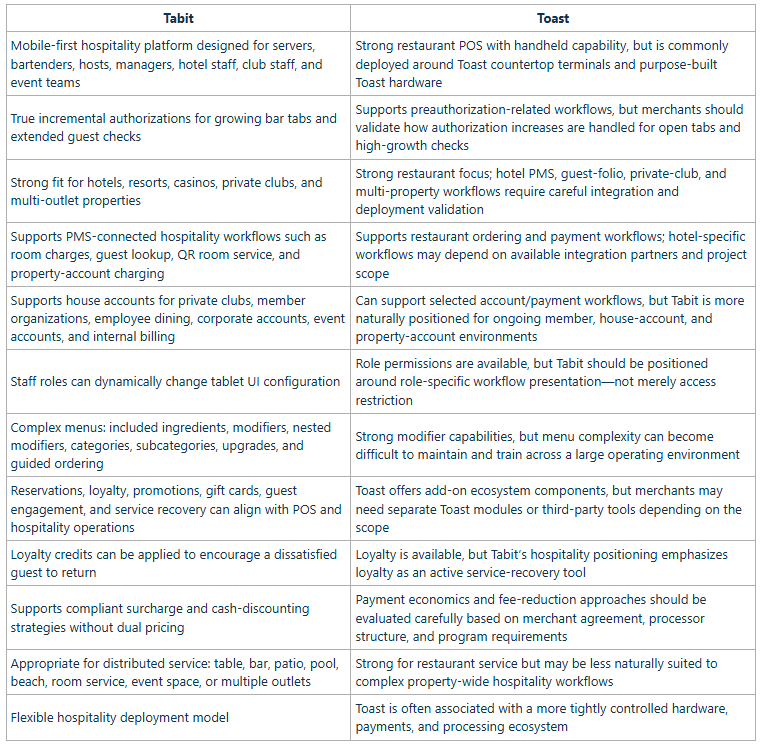
Where Tabit Wins
1. True Incremental Authorizations for Bar Tabs
Tabit has a meaningful advantage for operators that maintain open tabs and long-running checks.
Bars, lounges, bottle-service venues, private clubs, resorts, hotel bars, casinos, and full-service restaurants often start a tab with a relatively small initial authorization. As the guest continues ordering, the final bill can exceed the original amount by a wide margin.
This creates risk if the merchant settles materially above the original authorization without obtaining additional authorization coverage. In many operational conversations, this is discussed as the risk of exceeding the card brand 120% - 130% preauthorization tolerance amount and potentially triggering an automatic chargeback.
Tabit supports true incremental authorizations so the authorization can increase as the tab grows.
Guest opens a $25 bar tab → Guest continues ordering food and beverages → Check grows to $125 → Tabit supports additional authorization coverage → Final transaction is better aligned with the approved amount → Merchant reduces unnecessary payment exposureTabit message
“A bar tab is not a one-time transaction. It is an evolving guest check. Tabit helps the merchant keep the authorization aligned with the tab as it grows, rather than relying only on the opening preauthorization.”
Toast vulnerability
Toast can support preauthorization workflows, but do not assume its standard implementation provides the same true incremental authorization workflow in every scenario. Make Toast prove how it handles:
- Tabs that grow beyond the opening authorization
Discovery questions
- What is the typical opening preauthorization amount?
- How often does the final check exceed the opening authorization?
- How are high-value bottle-service checks handled?
- Have you experienced authorization-related declines, disputes, or chargebacks?
2. Better Fit for Hotels, Resorts, and PMS Workflows
Tabit has a stronger hospitality story for hotels, resorts, casinos, and multi-outlet properties.
Toast is a strong restaurant platform. Tabit is better positioned when the restaurant is part of a larger hospitality property and needs to participate in the guest’s full stay.
Tabit can support hospitality workflows involving:
- Room charges, Guest lookup by room or name
- Guest-folio workflows
- Property accounts, House accounts
- QR room-service ordering
- Poolside ordering, Beach service, Casino service, Event and banquet service
- Multi-outlet food-and-beverage operations
- Restaurant, bar, room service, and event workflows within one property
Tabit message
“Toast is a restaurant system. Tabit is a hospitality operating platform for properties where the restaurant is only one part of the guest experience.”
Toast vulnerability
Make Toast demonstrate the following rather than accepting a generic “we integrate with hotels” answer:
- Which PMS platforms are supported?
- Is room charge a native workflow or an integration project?
- Can staff search a guest by room and name?
- Can room service be ordered by QR code?
- Can orders route directly to the correct / local kitchen or bar station?
- Can a guest charge a meal from the pool, beach, patio, restaurant, or room to the correct folio?
- Can the front desk review appropriate check detail?
Best Tabit targets
- Boutique hotels, Resorts, Casino resorts, Golf resorts, Ski resorts, Beach resorts
- Hotels with multiple F&B outlets, Hotels with in-room dining
- Properties with poolside or cabana service
- Hotels with restaurants, bars, banquets, catering, and event spaces
- Hospitality groups operating restaurants inside hotels
3. Stronger Private Club and House-Account Story
Tabit is a stronger fit for private clubs, member organizations, corporate campuses, employee dining, golf clubs, country clubs, yacht clubs, social clubs, athletic clubs, and account-based hospitality operations.
House accounts matter because not every guest settles every purchase immediately by credit card.
A club may need to charge a member account. A hotel may need to charge a room folio. An event venue may need to bill the host. A company may need to charge food and beverage to a department. A corporate dining program may need employee accounts. A golf club may need members, guests, event accounts, and beverage-cart transactions to settle differently.
Tabit can support house-account and account-based hospitality workflows.
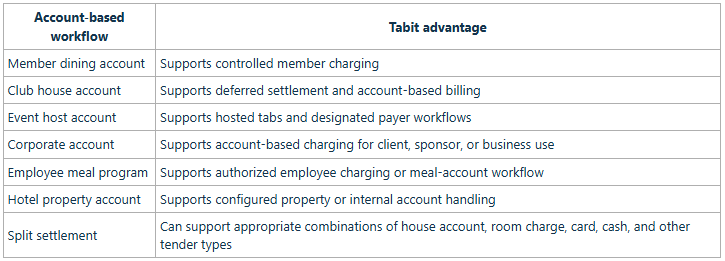
Tabit message
“Tabit is not limited to ‘pay now with a card.’ It fits hospitality businesses where members, guests, rooms, events, and departments may settle differently.”
Toast vulnerability
Ask Toast to demonstrate—not simply confirm verbally:
- Member account creation and lookup
- Corporate / member account reporting
- Mixed room charge, house-account, card, and cash settlement
- Account balance visibility
- Account-based reporting and statements
4. Mobile-First Hospitality Versus Terminal-Centered Restaurant POS
Toast is well known for restaurant hardware and handhelds. Tabit’s advantage is the way it positions the entire operation around mobile hospitality service.
Tabit is designed for the reality that service often happens away from the counter:
Restaurant table Bar stool Patio Private dining room Poolside chair Beach cabana Casino floor Golf course Banquet space Hotel room Resort amenity area Club dining roomTabit can give each employee a role-specific tablet experience appropriate to the task.
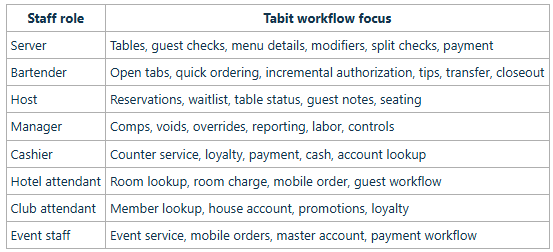
Tabit message
“Toast puts a powerful device in the restaurant. Tabit puts the right hospitality workflow in the hands of every role, wherever the guest is being served.”
Toast vulnerability
Toast should demonstrate how its handheld workflow changes by role:
- Does a host see a host workflow rather than a server workflow?
- Can hotel staff use a guest/room-charge workflow?
- Can club staff use a member-account workflow?
- Can the UI be simplified for each job rather than merely restricting permissions?
5. Better Fit for Complex Hospitality Menus
Tabit is a strong option when the menu is complex enough that ordering errors, missed modifiers, weak upselling, or staff training create operational problems.
Tabit supports:
- Included ingredients, Required modifier choices, Optional modifiers, Nested modifiers Paid upgrades.
- Categories, Subcategories, Preparation instructions, Detailed item configuration and alergies
- Guided ordering, Outlet-specific menus, Centralized catalog and pricing control
Example
Entrée: Grilled Salmon Included: • Seasonal vegetables • Herb rice • Lemon butter sauce
Server choices: • Substitute mashed potatoes • Add side salad • Sauce on side • Double vegetables • Gluten-free preparation request
Nested modifier: • Choose side salad  → Choose dressing
Tabit can guide the employee through the correct decisions without requiring the server to memorize every ingredient, included side, upgrade, preparation rule, and add-on price.
Tabit message
“The POS should teach and guide the employee. Tabit can show what is included, what must be selected, what can be upgraded, and what decision needs a follow-up choice.”
Toast vulnerability
Ask Toast to demonstrate the merchant’s real menu—not a simple demo burger:
- Can it show included ingredients clearly?
- Can staff remove an included ingredient intuitively?
- Can modifiers have nested follow-up decisions?
- Can the merchant separate included items, required choices, optional additions, and paid upgrades?
- Can the menu stay understandable for a new employee?
- Can complex categories and subcategories be navigated quickly?
- Can item configuration remain efficient on a handheld?
- Can the same menu logic work across restaurant, bar, hotel, room service, and event outlets?
6. Reservations, Loyalty, Promotions, and Service Recovery
Tabit is a strong fit for merchants that want customer engagement to be part of hospitality operations—not a separate bolt-on marketing tool.
Tabit can support a connected strategy around:
- Reservations, Waitlist, Guest data
- Loyalty, Promotions, Gift cards
- Online ordering and third party delivery
- Guest recognition, Marketing offers, Service recovery, Return-visit incentives
One particularly useful feature is the ability to give a dissatisfied guest a loyalty credit.
Guest reports a poor experience → Staff or manager resolves the concern → Authorized employee adds a loyalty credit → Guest receives a reason to return → Merchant can track whether the recovery offer is redeemedTabit message
“A service recovery should not disappear into a manager’s apology. Tabit can turn it into a measurable guest-retention action by placing an approved credit directly into the guest’s loyalty account.”
Toast vulnerability
Toast has loyalty and marketing options, but make Toast demonstrate whether its workflow supports:
- An immediate service-recovery credit
- Guest lookup at the point of service
- Reservations, waitlist, loyalty, and POS operating from a connected workflow
- Promotions that can be applied consistently across channels
- Guest-recognition data accessible to the right staff role
7. Better Hospitality Fit for Surcharging and Cash Discounting
Tabit supports compliant surcharge and cash-discounting strategies without requiring a dual-pricing approach.
This matters when a merchant wants to reduce payment acceptance costs but does not want:
- Separate cash and card menus
- Confusing guest-facing price displays
- Manual cashier decisions
- Inconsistent fee application
- Improvised staff explanations
- Different treatment at different outlets
- A program that does not work across restaurant, bar, room-service, club, and mobile-service workflows
Tabit message
“The payment-cost strategy should be built into the POS workflow, with consistent disclosure and application—not handled through a confusing dual-price menu or staff improvisation.”
Toast vulnerability
Ask Toast:
- Does the proposed payment-cost program use dual pricing?
- How does the POS show the fee to the guest?
- How is the charge represented on the receipt?
- Does it work consistently for table service, bar tabs, online ordering, QR orders, and room charges?
- Can staff explain it clearly?
- Can it be applied across multiple outlets?
- Does the merchant have to use a specific processor or pricing structure?
- What controls prevent accidental inconsistent application?
Positioning guardrail: Do not make legal, card-brand, or merchant-savings claims without validating the proposed program and merchant location. Do not call any payment-cost program “no-cost processing.”
8. Less Dependence on Separate Systems
Tabit can be positioned as a connected hospitality stack rather than a collection of separate modules.
A hospitality operator may otherwise need separate tools for:
POS Payments Handheld ordering Bar tabs Incremental authorizations KDS Online ordering QR ordering Reservations Waitlist Loyalty Promotions Gift cards House accounts Room charge PMS integration Guest management Reporting Multi-outlet managementTabit message
“The goal is not to buy the most modules. The goal is to eliminate disconnected workflows that create duplicate data, extra training, manual reconciliation, and inconsistent guest experiences.”
Toast vulnerability
Toast has a broad ecosystem, but the sales team should map what requires:
- A separate Toast subscription
- A paid module
- A third-party integration
- An implementation project
- Additional hardware
- Separate support escalation
- A processor commitment
- Different configuration by venue or outlet
The merchant should see the full operational stack and total cost—not just the price of the core POS.
Tabit vs Toast: Battlecard
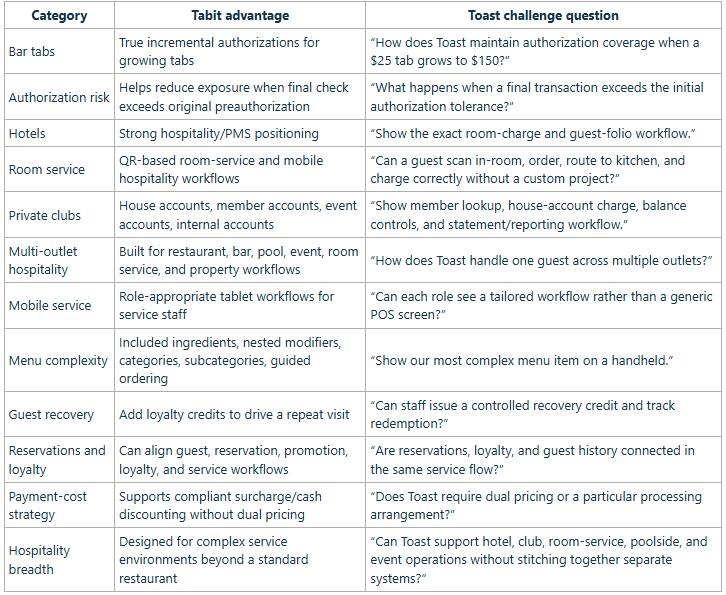
Tabit Discovery Questions
Use these questions to identify Tabit opportunities against Toast:
- How often does the final tab exceed the original preauthorization? Have you experienced automatic chargebacks?
- Does service occur only at tables, or also at the bar, patio, pool, beach, event space, private dining room, or guest room?
- Are you part of a hotel, resort, casino, private club, or multi-outlet property?
- Do you need room charges, guest lookup, PMS integration, or QR room service?
- Do members, employees, departments, event hosts, or corporate customers need to charge to an account?
- How complex is your menu? Do prep tickets route to different stations depending on the area?
- Do staff need to see included ingredients, follow-up choices, or nested modifiers?
- Do you need categories and subcategories to simplify menu navigation?
- Do servers, bartenders, hosts, managers, need different screen configurations?
- Do you currently use separate systems/apps for POS, reservations, loyalty, promotions, guest management, KDS, room charge, and online ordering?
- What happens when a guest has a poor experience? Can staff issue a recovery offer that encourages a return visit?
- Are you considering a surcharge or cash-discount strategy?
- Are you trying to reduce separate vendor relationships, duplicated data, and manual reconciliation?
Tabit Proof Points to Demonstrate
A Tabit demonstration against Toast should focus on real operational workflows rather than generic feature screens.
Payment and Bar Workflow
- Show the original authorization amount.
- Add additional orders.
- Demonstrate incremental authorization handling as the tab grows.
- Split the check by guest, item, seat, or tender.
Complex Menu Workflow
- Show an item with included ingredients.
- Use required modifier choices.
- Show a nested modifier.
- Show categories and subcategories.
Role-Based Interface
- Show the server experience.
- Show the bartender experience.
- Show the host/reservation experience.
Hotel, Resort, or Club Workflow
- Search for a guest by room or name.
- Demonstrate QR room-service ordering.
- Show how restaurant, bar, pool, and room-service activity can be handled across the property.
Guest Retention Workflow
- Find a loyalty guest.
- Add an authorized service-recovery credit.
Objection Handling
“Toast is the restaurant standard.”
Toast is a strong restaurant platform. The question is whether the operation is simply a restaurant or whether it is a more complex hospitality business.
“If you need a standard restaurant POS, Toast may be a reasonable comparison. If you need mobile service, open-tab controls, hotel workflows, private-club accounts, room charges, complex menus or area-based printer routing, role-based tablet experiences, and guest recovery across multiple outlets, Tabit is built for that level of hospitality complexity.”
“Toast already has handhelds.”
A handheld device is not the full differentiator.
“The question is not whether the staff can carry a device. The question is whether the device gives each role the right workflow—server, bartender, host, hotel attendant, club attendant, manager, or event team—and whether it supports the property’s payment, account, guest, and service model.” Ask your Toast prospect if they have a box of broken handhelds.
“We only need basic bar tabs.”
Ask how tabs are managed today.
“If a $25 authorization turns into a $150 final tab, what protects the merchant? Tabit’s incremental authorization capability becomes increasingly important as volume, check size, bottle service, and service duration grow.”
“We already have a PMS.”
That makes the Tabit conversation more relevant.
“Tabit is not replacing the PMS. It is connecting the food-and-beverage workflow to the guest and property workflow, including room charges, guest lookup, QR ordering, kitchen routing, and multi-outlet hospitality service.”
“We already use a loyalty program.”
Ask whether loyalty can actively recover an unhappy guest.
“Can an authorized employee add a controlled credit to a dissatisfied guest’s account at the moment of service? Can you track redemption and determine whether the guest came back? Tabit lets loyalty become a guest-recovery tool, not only a points program.”
“Our operation is too complicated to change POS systems.”
That is often exactly why Tabit should be evaluated.
“The goal is not to simplify your operation to fit the POS. The goal is to configure the POS around your operation—your menus, staff roles, outlets, room charges, house accounts, payment controls, and guest experience.”
Tabit Closing Talk Track
“Toast is a capable restaurant POS. Tabit wins when the merchant’s operation is more hospitality-intensive than a standard restaurant workflow. Tabit brings mobile service, complex menu control, true incremental authorizations, hotel and room-charge workflows, house accounts, role-specific tablet UI, reservations, loyalty, promotions, and guest recovery into one connected hospitality platform that is processor agnostic and free from Toast's semi-annuall increases.”
“If you run a busy bar, upscale restaurant, hotel, resort, private club, casino, event venue, or multi-outlet property, the question is not just how you take an order. The question is how you manage the full guest experience—from the first reservation or room-service QR order through table service, bar tabs, account charging, payment, loyalty, and the next return visit.”